
Clear Speech Takes Time (and That’s Okay)
Introduction
Speech sound errors are one of the most common reasons children are referred to a Speech and Language Therapist. Parents and schools often raise concerns when a child says “tat” for cat or “gog” for dog, particularly when this begins to impact how well they are understood by others.
Children do not learn all speech sounds at once. Instead, they use predictable patterns as their speech system develops. While these patterns are often typical in younger children, they can sometimes persist and affect a child’s confidence, participation, and learning at home and in school.
This blog explores what speech sound errors are, why they occur, and how they can be supported.
What Are Speech Sound Errors?
Most speech sounds are established by around three years of age; however, some develop later in childhood. It may not be until a child is six or seven years old that all sounds are used consistently and accurately (RCSLT, 2024).
You may hear the term phonological processes. This refers to patterns of sound changes that children use to simplify speech while they are learning to talk. Common examples include:
- Final Consonant Deletion- leaving off the final sound in a word (e.g., “ca” for cat)
- Weak Syllable Deletion- deleting the weak syllables in words (e.g., banana becomes “nana”)
- Fronting- replacing a back sound (/k/, /g/) with a front sound (/t/, /d/), e.g., cat becomes “tat”
- Backing- replacing a front sound with a back sound, e.g., dog becomes “gog”
- Stopping- replacing longer sounds such as /f/ or /s/ with shorter sounds like /p/ or /b/, e.g., fan becomes “pan”
- Gliding- replacing /r/ or /l/ with /w/, e.g., “wabbit” for rabbit
- Cluster Reduction- deleting part of a consonant cluster, e.g., spider becomes “pider”
Many of these patterns are developmentally appropriate in younger children, but support may be needed if they continue beyond the expected age
How do Speech Therapists Support?
Therapists use evidence-based approaches tailored to each child’s needs, including:
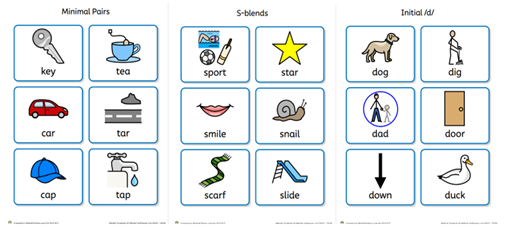
- Minimal Pairs- using word pairs that differ by one sound to show that sound changes meaning e.g., Key Vs Tea
- Multiple Oppositions- targeting several sounds at once when one sound is substituted for many
- Cycles Approach- focusing on different sound patterns in short blocks over time
- Auditory Discrimination- developing the ability to hear differences between sounds
- Phonological Awareness- strengthening listening skills that support speech and literacy
- Articulation Therapy- teaching how to produce a specific sound accurately in isolation, with a vowel, at word level, and a sentence/ conversational level
Supporting Children at Home and in School
Small, consistent strategies make a significant difference:
- Model clear speech without asking for repetition
- Give children time to think and respond
- Reduce pressure and avoid over-correcting
- Provide short, regular practice opportunities
- Praise effort and build confidence
Conclusion
Clear speech develops step by step, and progress often happens gradually. With consistent support, encouragement, and understanding from adults, children can make great improvements. Each milestone, no matter how small, reflects meaningful growth in both communication and confidence.
References
Royal College of Speech and Language Therapists (2024) Speech sound disorders. Available at: https://www.rcslt.org/speech-and-language-therapy/clinical-information/speech-sound-disorders/#section-2 (Accessed: 13th February 2026)
Disclaimer: The views and opinions expressed in blog posts are solely those of the individual author and do not necessarily represent those of Plymouth Learning Partnership CIC. The content is provided for general information and educational purposes only and should not be relied upon as professional or legal advice. Plymouth Learning Partnership CIC accepts no responsibility or liability for any errors, omissions, or actions taken in reliance on this content. The individual author is responsible for ensuring that any third-party material used (including text, images, and media) does not infringe copyright. Plymouth Learning Partnership CIC does not accept liability for any unauthorised use of copyrighted material by the individual author.